





Similarly to diamonds, coloured gemstones can be classed using the 4C method : Colour, Clarity, Cut and Carat weight.
To date however, there is no price list indicating the exact value of a stone. Only diamonds have a monthly listing in dollars (Rapaport list). Here are a few basic rules to give you an idea of a stone’s quality. The value is determined by the market.
1. The colour of a stone
This is by far the most important factor and the most difficult to master.
Indeed, a slight difference in colour or in the colour saturation can considerably increase the value of a stone. Colours are described using three criteria :
- Hue
- Tone
- Saturation
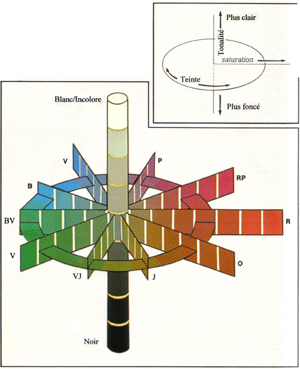
a. Hue :
This is the dominant colour, in other words :
– Primary colours : red, yellow, blue.
– Complementary colours : orange, green, purple.
See the colour wheel below :
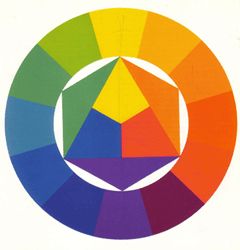
For example, green could be defined in three ways: bluish-green / green / yellowish-green.
b. Tone :
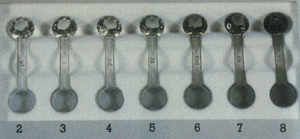
A colour can range from very light to very dark on a scale of 1 to 10. Number 1 is transparent (white) and number 10 is black. In the field of coloured gemstones, tones ranging from “very light” to “very dark”, or 2 to 8, are generally used.
c. Colour saturation :
Ranging from slight to intense, this describes the intensity of the colour :
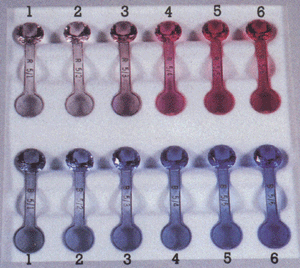
Conclusion : Each stone has its own range of hue, tone and saturation. Within this range, only a small part is considered (on the market) as being the most beautiful colour. This small part will determine the highest price for a stone of the chosen colour. Consequently, the further you move away from this range, be it in any one of the three criteria or in all three, the lower the price will be.
Our advice : When choosing, concentrate particularly on the colour that you like most, even if this means making concessions on clarity or weight.
2. Clarity of a coloured gemstone
By nature, some substances are naturally clearer than others. When choosing you will need to look at the clarity of the substance and determine whether the stone is within the norm or whether it has more inclusions than usual.
All stones can be classified in three categories :
- Often without inclusion : Type 1.
- Generally included : Type 2.
- Almost always included : Type 3.
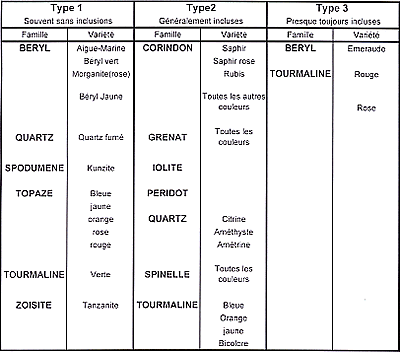
Conclusion : The value of a stone varies depending on the type and its rank: it is very rare to find a very clear emerald (ranked 3) and for this reason, the price will be higher.
When choosing :
Avoid stones that have inclusions in the setting zone, as such inclusions often present a risk of breakage.
A stone that has no inclusion at all is often a synthetic stone or an imitation.
A stone can also be appreciated in relation to its shape and the nature of the inclusions.
3. The cut : an often neglected criterion
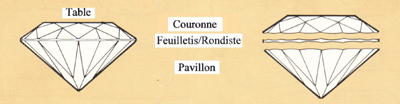
The proportions of a stone :
By proportion, we mean the beauty of the stone’s shape, in other words, its external form and the ease with which it will be mounted. Consequently :
a. External shape :
- Symmetry of the shape :
Is the circle really round ? Is the oval, deformed, etc. ?
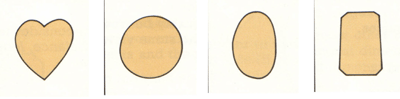
- Length/width ratio :
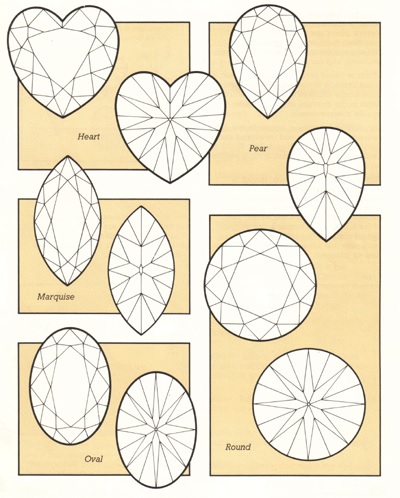
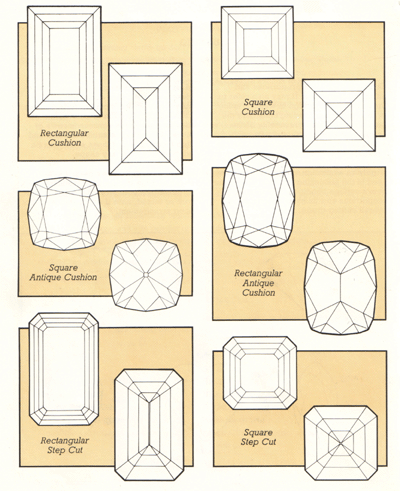
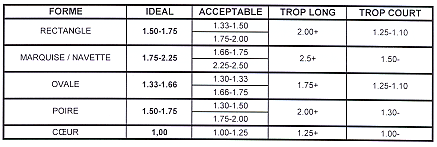
Our advice : Avoid unsightly shapes !
b. The ratio between the thickness of the crown and the depth of the pavilion :
A ratio of 1:3 is ideal (in order words: 1 mm for the crown/upper part and 3 mm for the pavilion/lower part).
Our advice : Always make sure that the depth of the pavilion is long enough. Generally speaking, a pavilion angle of 42 degrees will prevent light from reflecting and the gem will not shine. A pavilion angle between 65 and 42 degrees is acceptable.
If the pavilion is too thick, you risk having very high jewellery with the weight of the stone being too high in relation to its dimensions. Never forget that the price of a stone is based on its weight (carat).
c. The table :
The width of the table is compared to the width of the stone.
A ratio of 35% to 65% is an acceptable limit.
Ration = (width of the table / width of the stone) x 100 = percentage
Example :
Width of the table = 5mm ;
Width of the stone = 10mm
Ration = (5mm / 10mm) x 100 = 50%.
Our advice : The table is the light shaft of your stone. You should pay special attention to it.
d. Misalignment of the pavilion :
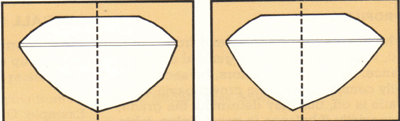
The art of lapidary is without a doubt, one of the most difficult aspects of our job as a cutter : positioning the colour in the stone’s pavilion.
Particularly for gems that have :
- Colour zones
- Different colours or colour tones depending on the angle from which the soon is observed (pleochroism). This is the case for corundum (sapphires, rubies, coloured sapphires), tourmaline and others.
The tip of the pavilion, or even the entire pavilion, is often misaligned in such stones.
The lapidary’s choice, is therefore to :
- Choose a more colourful zone of the stone which will be more “interesting from a commercial point of view”, in order to spread the colour throughout the stone (reflection/refraction/pleochroism)
- Remove an inclusion that is too visible in the crystal
- And sometimes optimise the shape of the rough in order to lose as little weight as possible during cutting.
Our advice : As lapidaries, we can only ask for the indulgence of the future buyer. Bringing out the best colour, without losing too much weight is the least we can do for these ancient crystals. Nevertheless, a magnificent colour with no brilliance is a lot less attractive than a slightly less beautiful colour that sparkles. The misalignment of the pavilion will have a direct impact on the brilliance of your stone. A good balance of the different criteria outlined above is the result of the lapidary’s craft.
4. The weight of a coloured gemstone
This is a purely commercial consideration.
The gemstones are sold per carat (1 carat = 0.2 grammes).
The heavier the gemstone, the higher the price per carat.
For example, a 2.00 carat sapphire is worth less per carat than a 3.00 carat sapphire.
Above a certain weight, some of the most beautiful gemstones become rare and their price is comparatively exponential.
In this way, a beautiful 1.5 carat ruby might be worth 1,000 Euro per carat while a non-heated, 6-carat Burmese one will easily exceed 15,000 Euro per carat if not 150,000 Euro.
To conclude our introduction to choosing a stone, our best advice would be : to take your time, trust your own taste, do ask for a “gemmological certificate” from an independent laboratory and above all, compare.
We are at your disposal to answer any questions or provide additional explanations.
Learn more about the treatment of gems
Advice for choosing a diamond
Learn about the characteristics of diamonds necessary for assessing their current market value and note the necessary precautions to take when buying.
Diamant-Gems’ staff advise and guide you in your choice so that you find the stone that suits you !
